


When woodworkers begin building out a shop, the table saw is often considered the default first machine purchase. While a table saw is certainly a capable tool, there is a strong case for making a bandsaw your first large shop tool instead.
A quality bandsaw is one of the most versatile machines in woodworking. It excels at cutting curves, shaping parts, resawing lumber, and breaking down stock safely and efficiently. With the right setup and a few simple jigs, a bandsaw can even perform tasks commonly associated with a table saw and a jointer, making it an ideal choice for woodworkers who are just getting started and working with limited space or budget.
Why Start with a Bandsaw?
The bandsaw’s greatest strength is its flexibility. Unlike many machines that are designed for a narrow set of operations, the bandsaw can adapt to a wide variety of woodworking tasks.
Some of the most common uses include:
- Cutting curves and irregular shapes
- Resawing thick lumber into thinner boards
- Creating veneers
- Rough-cutting parts to size
- Making tenons and other joinery
- Cutting bowl blanks and turning stock
- Processing reclaimed lumber
Because the blade cuts downward into the table with a small portion of the blade exposed, the bandsaw is also considered one of the safer stationary woodworking machines. There is no equivalent to table saw kickback, and the narrow kerf wastes less material while requiring less power to make cuts.
Replacing Some Table Saw Functions
While a bandsaw cannot completely replace a table saw, it can perform many of the same operations.
With a simple fence installed, the bandsaw can rip boards to width. In fact, many woodworkers prefer using a bandsaw for rough ripping because it is safer and places less strain on the machine. After ripping, the edge can be cleaned up with a hand plane or sanding block.
Crosscutting can be accomplished using a miter gauge or shop-made sled. While the cuts may not be furniture-ready directly off the blade, they are often accurate enough for rough dimensioning and small projects.
For hobbyists building boxes, cutting boards, small furniture, and shop fixtures, a bandsaw can handle a surprising percentage of the work that might otherwise require a table saw.
A Bandsaw Can Even Help Replace a Jointer
One of the most useful tricks for small-shop woodworkers is using a bandsaw with a jointing sled.
A simple straight-line ripping jig allows you to flatten one edge of a board by referencing a straight guide against the fence. Once the first edge is straight, the board can be flipped and the opposite edge cut parallel.
While this method is slower than using a dedicated jointer, it works remarkably well for small projects and occasional milling tasks. For many beginner woodworkers, this can delay or eliminate the need to purchase another expensive machine.
Making the Most of Your Investment
If the bandsaw will be your primary machine, a few upgrades are worth considering:
Invest in Quality Blades
Many frustrations with bandsaws come from poor blades rather than the machine itself. A good blade matched to the task can dramatically improve performance.
- Narrow blades for tight curves
- Wider blades for straight cuts and resawing
- Coarse tooth patterns for thick stock
- Fine tooth patterns for thinner materials
Build a Few Simple Jigs
A handful of shop-made accessories can greatly expand the capabilities of your bandsaw.
Consider building:
- A tall resaw fence
- A circle-cutting jig
- A pattern jig
- A straight-line ripping sled
- A small crosscut sled
These projects require little material but provide significant functionality.
Learn to Tune the Machine
Blade tracking, guide adjustment, and proper tension are essential skills. A well-tuned bandsaw cuts accurately, runs smoothly, and becomes a pleasure to use.
Spending an hour learning proper setup can save countless hours of frustration later.
Start with the Right Size
A 9-10” benchtop bandsaw is a common entry point for the beginner and suitable for a small garage or basement space. A 14’ bandsaw with a mobile base provides for cutting of wider and thicker panels. Starting with the small option is a nice lower cost option from which you can upgrade as your skills grow and if you find the need for the larger size.
Used Bandsaws are Plentiful
A bandsaw lasts a long time if well-maintained. I have used 50+ year old bandsaws that are better than new ones from new mass market brands. Start by checking Facebook Marketplace and Craigslist as there are usually dozens of bandsaws available that are in excellent condition at reasonable prices. Expect to pay between $50 to $100 for benchtop bandsaw and $250 to $400 for a larger self-standing bandsaw. Feel free to email me if you want an opinion on what you find.
Buying a New Bandsaw
The variety of options from Home Depot, Lowes, and other big box stores do not offer as great a value compared to the offerings from woodworking suppliers. While Woodcraft may be convenient, ordering direct from the manufacturer can be a better option if you want to buy something new.
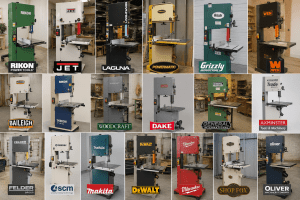
Two American brands I recommend are Grizzly and Rikon. Grizzly is a long-standing mainstay provider for a wealth of woodworking and machine tools. Rikon is a newer manufacturer offering an excellent line of woodworking tools at a highly reasonable price point. I find both of these brands to be of higher quality and lower price than the equipment available from Jet. You may also find references to Laguna who offer some of the best woodworking equipment. However, the price is usually double compared to those from Grizzly or Rikon. WEN and Harbor Freight have some nice offerings at fairly low-price points. And, while I love and have many tools from WEN and Harbour Freight, I prefer a high-quality used bandsaw for the same or lower price.
The Ideal Tool for the Small Shop
For woodworkers working in a garage, basement, or shared workspace, every square foot matters. The bandsaw delivers exceptional capability while occupying a relatively small footprint.
It can process rough lumber, create intricate curves, perform joinery, and prepare stock for countless projects. When paired with a few hand tools and shop-made jigs, it becomes the centerpiece of a highly capable woodworking shop.
Final Thoughts
If you’re building your first woodworking shop, don’t automatically assume that a table saw should be your first major purchase. A bandsaw offers versatility, safety, and tremendous value for the beginner woodworker.
While you may eventually add a table saw, jointer, planer, or other specialized machines, a good bandsaw will remain useful throughout your woodworking journey. It is one of the rare tools that continues to earn its place in the shop no matter how experienced you become.
For many makers, the bandsaw isn’t just another machine, it’s the foundation of a practical, efficient, and enjoyable woodworking shop.


Leave a Reply